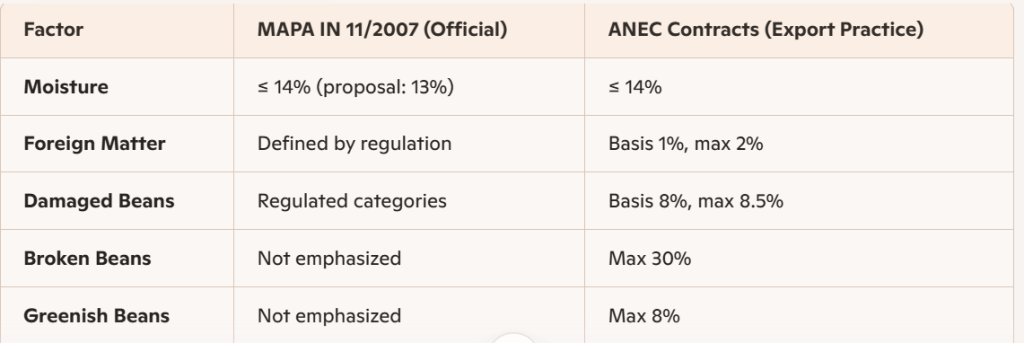
Brazil’s soybean grading standards are set by the Ministry of Agriculture (MAPA) under Normative Instruction 11/2007, but in practice most exports follow commercial contracts from ANEC (Brazilian Grain Exporters Association). The key limits are: moisture ≤ 14%, foreign matter ≤ 2%, damaged beans ≤ 8.5%, broken beans ≤ 30%, and greenish beans ≤ 8%. Recent proposals to reduce the moisture limit to 13% have stalled due to farmer opposition.
Brazilian exports are governed by ANEC 41 (FOB parcels) and ANEC 42 (FOB full cargo) contracts, referencing FOSFA (Federation of Oils, Seeds and Fats Association) methods:
Oil Content: Basis 18.5% (discounts apply if lower)
Toxic Seeds: Strict tolerance (1 particle per 1 kg sample per 5,000 MT lot)
Brazilian soybeans are a major import source; contracts typically specify ANEC standards, so traders should expect moisture ≤ 14% and damage ≤ 8.5% as baseline.